Who is getting sick from 9/11 now?
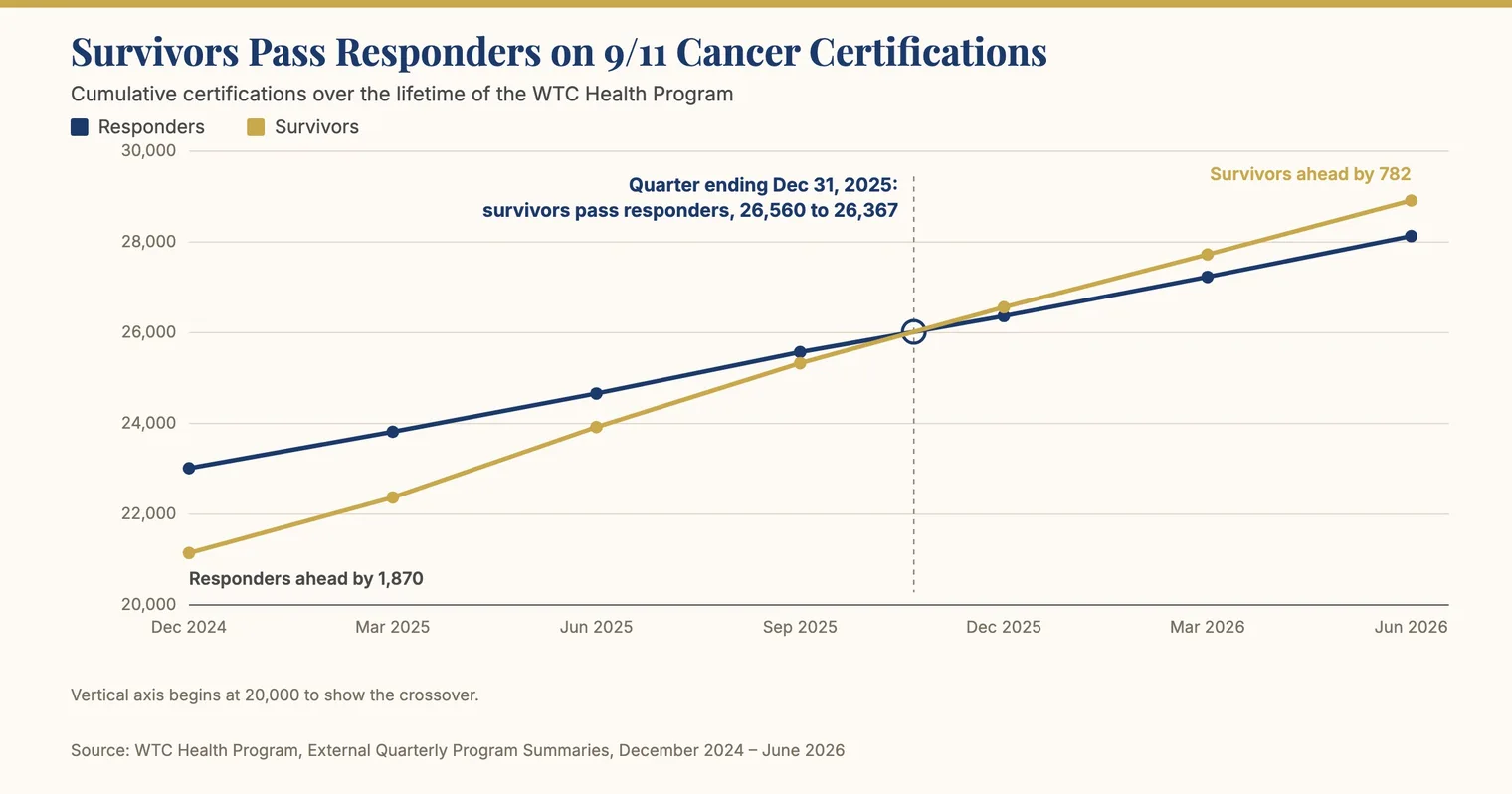
Survivors. As of June 30, 2026, the WTC Health Program had certified 28,913 survivors and 28,131 responders for a 9/11-related cancer over the lifetime of the program. That is a lead of 782, and it is the first time the survivor total has exceeded the responder total.
The past 12 months show the gap widening rather than closing. Of 10,393 cancer certifications in that period, 5,762 went to survivors and 4,631 to responders.
Two definitions matter before going further. A survivor is someone who lived, worked, attended school, or was otherwise present in the affected area. A responder performed rescue, recovery, cleanup, or fulfilled related duties. A certification is the WTC Health Program’s formal finding that a diagnosed condition is 9/11-related.
These figures come from the WTC Health Program’s latest data, published August 1, 2026. The WTC Health Program describes the data as preliminary and subject to revision.
When did survivors become the majority?
In two stages, nearly nine years apart.
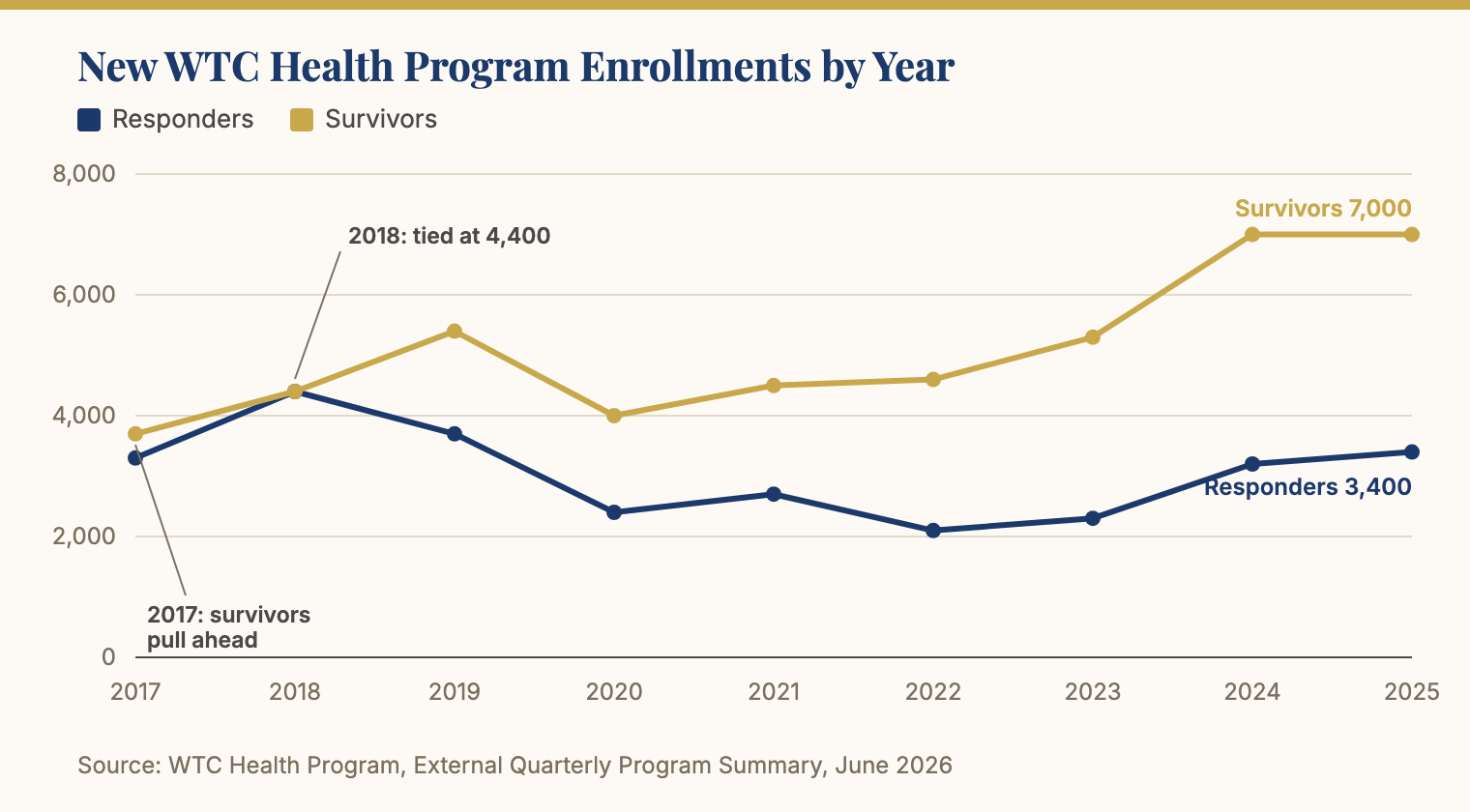
The first crossover was in new enrollments. Survivors first outnumbered responders among new enrollees in 2017. The two categories were tied in 2018. Since 2019, survivors have led every year, and the gap has widened rather than closed.
The second crossover took longer, and it is recent. In the WTC Health Program’s data through June 26, 2025, responders still led on cumulative cancer certifications by 741. By September 30 that lead had narrowed to 244. In the quarter ending December 31, 2025, survivors passed responders for the first time, by 193. The lead has widened every quarter since.
What makes that notable is that responders still outnumber survivors in the program overall, and by a wide margin. Of the program’s 154,700 members, about 95,200 are responders and only 59,500 are survivors, a gap built up in the early years, when responders enrolled first and in far greater numbers. Even as a minority of the program, survivors have passed responders on cancer certifications specifically.
The shift was foreseen. In 2019, the Congressional Budget Office reported that about 60 percent of all September 11th Victim Compensation Fund (VCF) cancer awards over the fund’s history had gone to responders, but that the survivor share of new cancer claims had already risen to 50 percent. It projected that share would keep climbing, because survivors make up the bulk of the remaining exposed population.
Why are survivors getting sick if they were not on the pile?
Because the exposure was not confined to the pile.
The collapse of the Twin Towers released a plume of pulverized building material across Lower Manhattan and beyond, carrying asbestos, silicates, dioxins, PCBs, heavy metals, and dozens of other known or suspected carcinogens. New York City’s WTC Health Registry estimates that roughly 400,000 people were exposed to 9/11 contaminants — 409,492, by the Registry’s own population estimate.
Dust did not stay outdoors. It entered buildings through ventilation systems and windows, and settled into elevator shafts, carpets, curtains, bedding, and upholstery. Residents were largely left to clean it themselves, often with minimal equipment. Meanwhile the fires under the rubble burned for about 100 days, adding new pollutants daily.
The result was sustained residential and workplace exposure over months, not a single event. Kimberly Flynn, director of 9/11 Environmental Action, has described the dust as having gone everywhere, and the epidemiological picture is still incomplete because so little exposure data was collected at the time.
It was sucked into HVAC systems; it came through closed windows.” — Kimberly Flynn, director of 9/11 Environmental Action
Why is this happening 25 years later?
Latency. Cancer takes years to develop after a carcinogenic exposure, and the WTC Health Program will not certify a cancer diagnosed before its minimum latency period has passed.
That is why the early years of the program looked so different. Aerodigestive conditions dominated first: chronic rhinosinusitis, asthma, GERD. Those appear within months or a few years. Cancers appeared later, as the latency windows opened one by one.
Minimum latency varies by cancer type. Blood cancers carry the shortest requirement at 146 days. Thyroid cancer requires two and a half years. Most solid cancers require four years. Mesothelioma requires up to eleven.
That shift is now visible in the totals. Cancer has become the single most certified condition category in the program, ahead of chronic rhinosinusitis at about 42,000 members and GERD at about 39,000. The conditions that defined the program’s first decade have been overtaken by the ones that took longest to appear.
Twenty-five years out, every latency window has opened. Anyone who was exposed in 2001 into 2002 and is diagnosed today can satisfy latency on its face for every covered cancer. You can see the full latency requirements by cancer type on our covered conditions page.
Which cancers are most common among survivors?
These numbers show the certification breakdown amongst members who are currently enrolled in the program, and most notably, do not include certifications for former members who have since died or otherwise left the program.
The WTC Health Program’s top ten cancers among currently enrolled members, as of June 30, 2026.
| Cancer | Certified Members | Responders | Survivors |
|---|---|---|---|
| Non-melanoma skin | 18,380 | 11,900 | 6,500 |
| Prostate | 13,170 | 6,900 | 6,300 |
| Breast, female | 4,830 | 700 | 4,100 |
| Melanoma of skin | 3,860 | 2,300 | 1,600 |
| Lymphoma | 2,560 | 1,000 | 1,500 |
| Thyroid | 2,460 | 900 | 1,500 |
| Kidney | 2,060 | 1,000 | 1,100 |
| Lung and bronchus | 1,970 | 700 | 1,300 |
| Bladder | 1,680 | 800 | 800 |
| Leukemia | 1,570 | 700 | 900 |
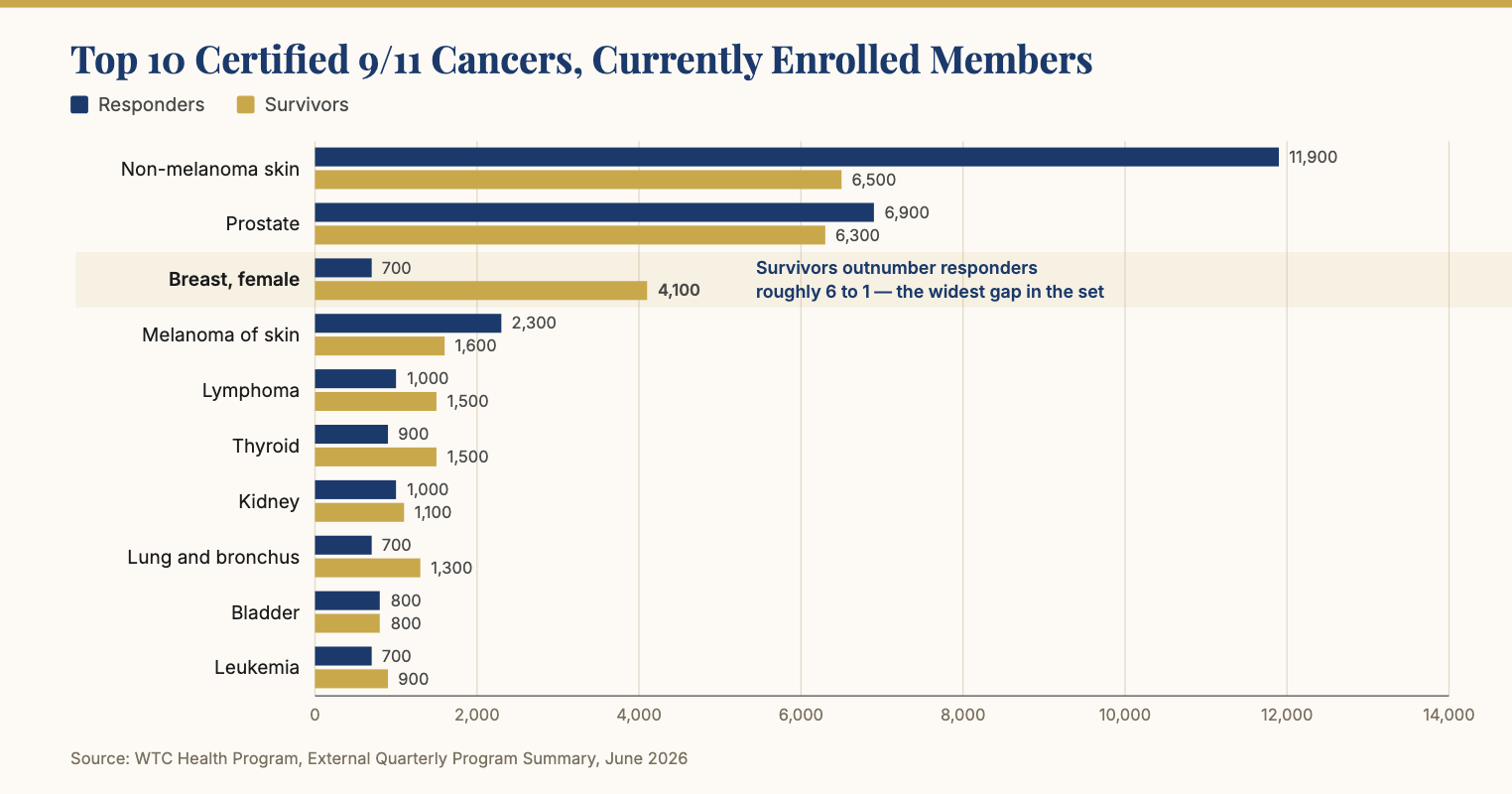
Note where survivors already lead: female breast, lymphoma, thyroid, kidney, lung and bronchus, and leukemia. Learn more about 9/11 skin cancer claims, prostate cancer, breast cancer, and thyroid cancer. Responder and survivor counts are rounded to the nearest hundred in the WTC Health Program’s source figure and may not sum exactly to the total.
Is the mix of 9/11 cancers changing?
Yes, and this is the part of the data that has drawn the least attention.
Compare the WTC Health Program’s ranked list from December 2014 with the current one. In 2014 the top five certified cancers were non-melanoma skin, prostate, non-Hodgkin’s lymphoma, melanoma, and thyroid. Today the top five certified cancers are non-melanoma skin, prostate, female breast, melanoma, and lymphoma.
The two lists are not counted the same way. The 2014 figures are instances of certified cancer across the whole program; the current figures count certified members who are still enrolled. The ranking comparison holds, but the underlying counts are not directly comparable.
Nearly twelve years later, the top two certified cancers remain in the same order, and melanoma still sits fourth. Lymphoma slipped from third to fifth and thyroid from fifth to sixth. The one cancer that climbed is breast, which ranked eighth in December 2014. It now ranks third.
It is also the most survivor-weighted cancer in the top ten by a wide margin. Of 4,830 members certified for female breast cancer, roughly 4,100 are survivors and 700 are responders.
Among currently enrolled members, the responder cohort is about 77,800 men to 10,900 women. The survivor cohort is closer to even, roughly 31,200 men to 25,500 women. As survivors become the majority of new certifications, the cancer mix necessarily shifts toward cancers that occur predominantly in women.
In other words, the composition of 9/11 cancer is changing, not only the volume. That has practical consequences. A woman who worked in an office near the towers in 2001 may not see herself in the public image of a 9/11 victim, and the certification data now says she should. Our 9/11 breast cancer page covers both female and male diagnoses, including the rare-cancer framework that applies to male breast cancer.
Where do you have to have been to qualify?
This is where most people get stuck, because the two programs do not use the same map or the same dates.
Free medical care through the WTC Health Program. Survivors qualify if they were present in the NYC Disaster Area: Manhattan south of Houston Street, plus any block in Brooklyn wholly or partially within 1.5 miles of the former World Trade Center site.
The survivor category is broad: residents, area workers, students and school staff, hotel guests, and people who cleaned contaminated buildings — anyone who was present but not performing response duties. Each route is set out on our 9/11 survivor eligibility page.
Responders qualify if they were in the WTC Responder Eligibility Area, which is Lower Manhattan south of Canal Street. Several other locations are covered separately rather than as part of that area: the routes of debris removal, barges and barge loading piers, the Fresh Kills Landfill on Staten Island, and the garages and vehicle-maintenance facilities that serviced WTC-response vehicles. Responders also qualify if they were at the Pentagon or in Shanksville, Pennsylvania.
The covered period for survivors and responders who were in New York runs from September 11, 2001 through July 31, 2002. For responders at the Pentagon it runs through November 19, 2001, and for Shanksville through October 3, 2001.
Compensation through the September 11th Victim Compensation Fund (VCF). All claimants may qualify if they were present in the NYC Exposure Zone: Manhattan south of Canal Street river to river, then north on East Broadway to Clinton Street and east on Clinton Street to the East River, plus the routes of debris removal.
The covered period for the NYC Exposure Zone runs from September 11, 2001 through May 30, 2002. Claimants may also qualify if they were present at the Pentagon from September 11, 2001 through November 19, 2001, or the Shanksville, PA site from September 11, 2001 through October 3, 2001.
Presence that qualifies you for health care does not automatically qualify you for compensation. If you were between Canal and Houston Street, any time you also spent below Canal Street may qualify you for both. Daily life in Lower Manhattan rarely stopped at Canal Street, and presence can be established with leases, school records, pay stubs, employment records, or witness statements from neighbors, friends, and coworkers.
Those boundaries were not drawn around the actual reach of the dust. Representative Jerrold Nadler, who co-sponsored the legislation, has since described the lines as arbitrary, and the choice as a financial one rather than a scientific one. We cover that history, and what it means for a claim, on our 9/11 exposure zone eligibility page.
In My Experience
More recently, victims calling our office are almost always the ones who never thought of themselves as victims of September 11.
They were accountants, paralegals, restaurant staff, delivery drivers, teachers, high school students, and building superintendents. They were not on the pile. Many were not in Manhattan on the day itself and came back to work or school within weeks, because they were told the air was safe. When they were diagnosed years later, nothing in the public story of 9/11 pointed them toward a connection.
The obstacle in these cases is almost never eligibility. It is self-recognition. I have had people apologize for calling, as though a cancer diagnosis were an imposition on a program built for firefighters. It was built for them too.
The second thing I hear is that too much time has passed. It usually has not. Depending on the cancer type and the diagnosis date, a claim may still be approved, and presence in 2001 or 2002 can be documented long after the fact.
The VCF’s claim filing deadline runs to October 1, 2090. What does expire is the individual registration window, generally about two years from the date a condition is certified, and that one can be missed.
If any of this describes you or someone in your family, a case review costs nothing and can help answer any questions you may have.