Why is Fresh Kills the “second Ground Zero?”
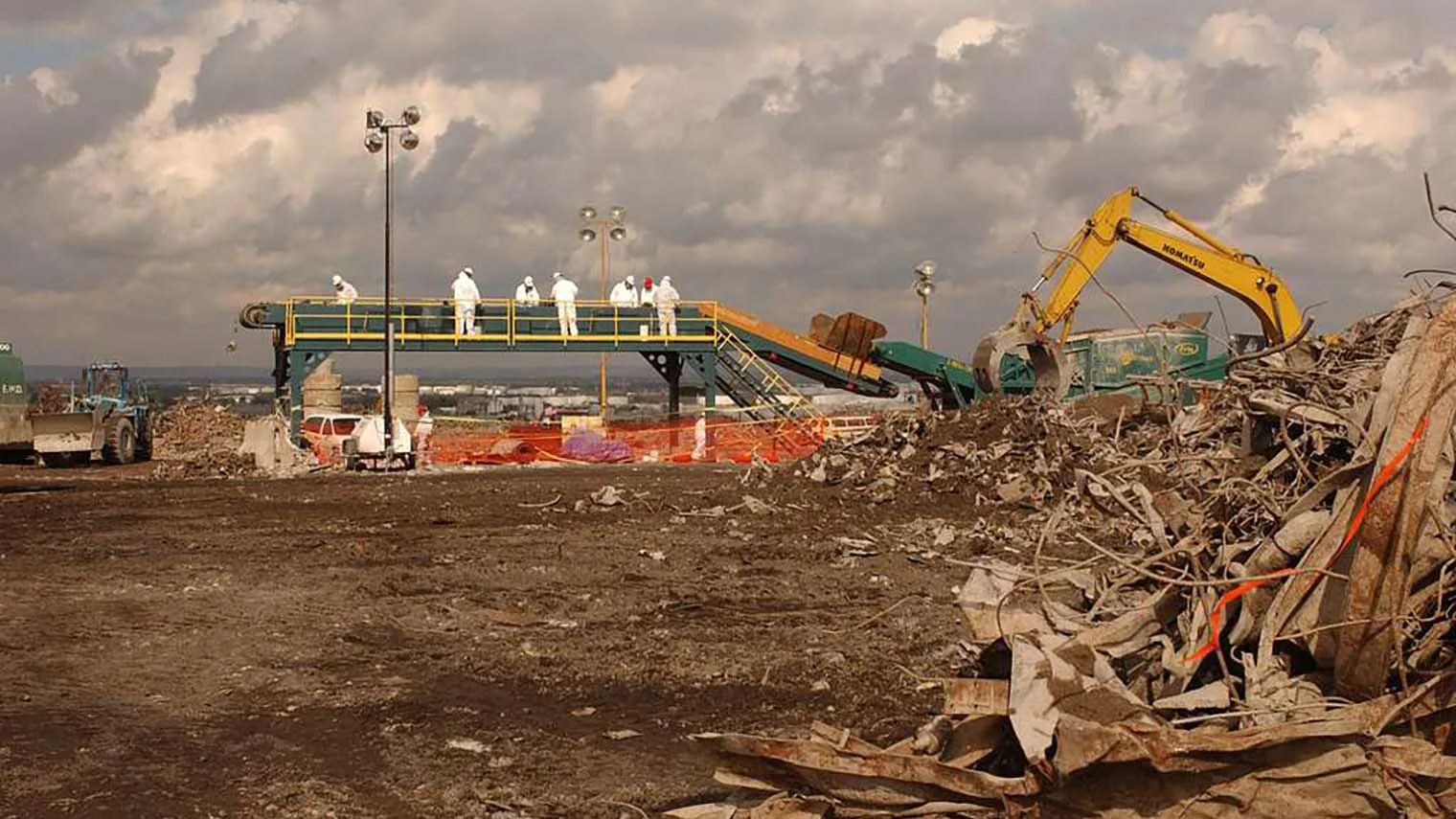
Fresh Kills closed as a working landfill in March 2001. Six months later, on the night of September 11, the state reopened it to receive debris from the World Trade Center. It stayed open for that purpose for ten months, taking in more than 1.8 million tons of material barged across the harbor. About 3,700 Sanitation Department employees, along with FBI, NYPD, and federal forensics personnel, sorted it around the clock.
This was not ordinary debris. It held pulverized concrete, asbestos, lead, and human remains, and workers sifted it by hand, sometimes through sieves as fine as a quarter inch. The operation recovered 4,257 human remains and more than 54,000 personal items. When it ended in July 2002, the remaining material was capped with clean soil and left on the hill.
Ground Zero was where the buildings fell. Fresh Kills was where what fell was taken, sorted, and, for many families, ultimately left. For the workers who spent ten months there, the two sites were never really separate.
Who currently qualifies for VCF compensation from Fresh Kills work?
The law that created the VCF and WTC Health Program, the Zadroga Act, covers Fresh Kills, its loading piers, and the debris barges as qualifying WTC locations, for anyone present during the exposure period, and who did recovery-related work during that time. That reaches:
- Sanitation workers who unloaded, staged, and sorted the debris
- NYPD, FBI, and other personnel who worked recovery and forensics
- Barge and pier workers who moved material across the harbor
- Contractors and support staff who participated in recovery efforts
- Vehicle maintenance workers who handled WTC dust-contaminated equipment
- Volunteers who sifted or handled debris during the qualifying window
Anyone in these categories with a WTC Health Program-certified condition may be eligible for free treatment and/or VCF compensation, including non-economic loss, economic loss, and, in fatal cases, wrongful death. The eligible condition(s) must be certified by the WTC Health Program, or in narrow cases through the VCF’s Private Physician Process.
What conditions are covered?
The WTC Health Program’s covered conditions list includes more than 70 cancers, dozens of lung, respiratory and digestive conditions, musculoskeletal disorders from the first year of work, and mental health conditions including PTSD, depression, and anxiety. The most common cancers in the broader 9/11 responder population are prostate, thyroid, non-melanoma skin cancer, and melanoma. VCF non-economic cancer awards typically range from about $90,000 for non-melanoma skin cancer to $250,000 for most other cancers, $300,000 for multiple cancers, and up to $340,000 for multiple, extraordinarily severe conditions.
A Fresh Kills worker with a certified condition doesn’t need the word “Fresh Kills” to do anything. The label that matters is “WTC responder,” and it unlocks the same treatment and compensation as anyone who worked the pile itself in Lower Manhattan.
Why don’t Staten Island residents qualify?
Because eligibility depends on what you did, not just where you lived. The Zadroga Act’s footprint is Lower Manhattan, a sliver of Brooklyn, the Pentagon, Shanksville, and the WTC recovery sites, including Fresh Kills and its debris routes. Staten Island as a whole isn’t in that footprint. Someone who lived in Great Kills or on Arden Avenue, a mile from the landfill, doesn’t meet the presence requirement, no matter what the air smelled like. Neither does a DSNY worker who was based at a garage near Fresh Kills but never handled the WTC debris.
That’s not an oversight. It reflects what the law had to work with when it was written. Congress covered the specific recovery operation because that specific group and activity was written into the statute. Staten Island’s cancer rates have been studied a few times over the decades, but never in a way built to isolate what, if anything, the ten-month WTC-debris window at Fresh Kills added on top of everything else. Without that study, there’s no comparable basis for the law to expand.
Practically: if you lived or worked near Fresh Kills but didn’t participate in 9/11 recovery work there, you cannot file a VCF claim or enroll in the WTC Health Program today on that basis alone. That doesn’t mean nothing happened to Staten Island. It means the question is still open.
What’s the deadline to register a Fresh Kills 9/11 claim?
The VCF runs through October 1, 2090. The clock that actually matters is personal: generally two years from WTC Health Program certification of a condition, or from another triggering event, to register. Most people who miss out don’t miss the fund’s outer deadline, they miss their own two-year window because they didn’t know it had started. If you handled 9/11 debris at Fresh Kills, on the barges, or at a pier, and have a diagnosis on the covered list, register now. It’s free and commits you to nothing.
In My Experience
I grew up about a mile from Fresh Kills. Before it was the second Ground Zero, it was just the dump. On the wrong wind you could smell it in the kitchen. You’d watch the crows leave every morning and come back at dusk, thousands of them, like a black cloud. Every kid on our side of the Island thought that was normal.
It wasn’t. In 2001 I remember the lights and the temporary buildings and the pile growing at Fresh Kills. In the years since, I’ve watched many people in my family get sick and die from cancer. I’ve watched friends do the same, especially the ones who grew up even closer, in Great Kills, right against the fence line. Every Staten Islander around my age has a version of this story.
Nobody knows for certain what’s causing this borough’s cancer rate. That’s the actual problem. The workers who sifted 9/11 debris are covered because Congress wrote them into the statute. The people who lived here their whole lives got studies that never asked the one question that matters: what did the WTC debris add?
Reading the city’s July 2026 numbers, and the Advance asking again why this borough has never had a real study, doesn’t feel like news to me. It feels like the conversation I’ve been having with people my whole life, in living rooms and at wakes.
I represent the workers the law recognizes. That’s the job. But as a Staten Islander, I don’t accept that only workers who handled debris are the end of the conversation. The nearby workers and residents deserve the same kind of answer. Until they get it, this borough’s numbers are going to keep getting filed away as somebody else’s coincidence.
What needs to change
The gap here isn’t a gap in the law. It’s a gap in the evidence the law has to work with. Two things would close it.
First, a Staten Island study built around the actual question: what did the ten-month WTC-debris window at Fresh Kills add on top of decades of ordinary landfill exposure? Not another general review. A real, funded, cohort-based study that finally isolates that period.
Second, if that study found something concrete, Congress has a potential path: amend the Zadroga Act. That mechanism exists and has been used before. What’s missing is the evidence to point it at.
To be clear, I’m not saying every Staten Islander with cancer has a claim, and I’m not saying residents’ exposure equals the responders. Under current law, residents and even DSNY workers who were at Fresh Kills but didn’t handle debris don’t qualify. What I am saying is that the reason they don’t qualify may be that nobody has asked the right question yet.
Staten Island has waited twenty five years for a real study. The workers who handled debris got their coverage because someone finally asked the right question about their exposure. The nearby workers and residents deserve the same chance.
Get a Free 9/11 Case Review
If you handled WTC debris at Fresh Kills, on the barges, trucks, or at the loading piers between September 2001 and July 2002, and you’ve been diagnosed with a condition on the WTC Health Program’s covered list, you may be eligible for free healthcare and/or VCF compensation. Baione Law represents 9/11 responders, survivors, recovery workers, and their families.
Call (212) 680-4000 or visit our contact page for a free case review.
You were there. We’ll be here.™