On the morning of every September 11, a small set of pauses structures the ceremony at the National September 11 Memorial in Lower Manhattan. Bells toll. Names are read. The city stops, briefly, six times. This year, for the first time, it will stop a seventh.
The 9/11 Memorial & Museum announced in May that the 25th anniversary ceremony will include a new moment of silence dedicated to the men and women who survived the day itself but later died of illnesses tied to their exposure to the toxic dust at Ground Zero, the Pentagon, and Shanksville, as well as the surrounding neighborhoods in New York City.
The seventh moment will fall at the end of the reading of the names and will be observed every year going forward.
The Six Moments We Have Always Observed
For nearly a quarter century, six pauses have marked the timeline of the attacks themselves. They are tied to specific clock times that almost everyone in our community can recite from memory.
- 8:46 a.m. American Airlines Flight 11 strikes the North Tower (1 WTC) of the World Trade Center.
- 9:03 a.m. United Airlines Flight 175 strikes the South Tower (2 WTC).
- 9:37 a.m. American Airlines Flight 77 strikes the Pentagon.
- 9:59 a.m. The South Tower collapses.
- 10:03 a.m. United Airlines Flight 93 crashes in a field in Shanksville, Pennsylvania.
- 10:28 a.m. The North Tower collapses.
Each pause is followed by the toll of a bell. Each one fixes the ceremony to a specific instant in time that changed everything that came after it.
The Seventh Moment
The seventh moment of silence is different. It is not anchored to a clock time. It is anchored to a process. The illnesses tied to 9/11 did not strike all at once. They came over years and decades. They are still coming.
Placing the new moment at the conclusion of the reading of the names is a deliberate choice. The names of the dead from that day are read in full, and then the ceremony pauses again, this time for the thousands who were taken later by the same attack.
The numbers behind the decision are sobering. The scale of post-9/11 illness is no longer in dispute. As the Special Master of the September 11th Victim Compensation Fund (VCF) stated in the program’s 2025 Annual Report, the number of people who have died from 9/11-related health conditions has now far surpassed the number who died on the day of the attacks.
- As of the end of May 2026, the VCF has received nearly 110,000 claims, including more than 9,400 filed on behalf of deceased claimants, and has awarded more than $18 billion to over 75,000 claimants.
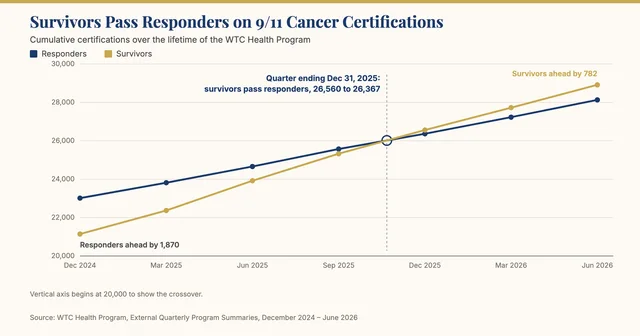
- According to the latest data from the World Trade Center Health Program, more than 54,000 cancer certifications have been issued to program members, with roughly 10,000 new cancers certified in just the past twelve months.
- Cancer is now the single most common certified condition in the program, ahead of chronic rhinosinusitis, GERD, asthma, and PTSD.
By every credible projection, these numbers will sadly continue to climb.
What I Have Seen
I have spent more than thirteen years working on September 11th Victim Compensation Fund and World Trade Center Health Program claims. In that time I have sat across the table from first responders, construction and demolition workers, volunteers, office workers, residents, teachers, students, and the surviving family members of people who did not live to file a claim of their own. Many were sick when I met them. Some did not live to see their cases resolved. Others are healthy today and trying very hard to stay that way.
What I can tell you, from that work, is that this seventh moment of silence is not symbolic in any small sense. It corrects something that has been wrong about the public memory of September 11 for a long time.
The attack did not end when the dust settled and the fires stopped burning. It is still ongoing. It is still claiming people who showed up, who stayed, who carried on, who went back to work and back to their apartments and back to their classrooms, who rebuilt Lower Manhattan because someone had to, and who paid for it later with their health.
Claudia Thomas, who led a 9/11 rescue and recovery team for the Port Authority and founded one of the first online forums for responders, survivors, and families, 9/11 Rescue Workers & Friends Forum, put it this way recently:
One cannot truly honor the memory of those who perished on 9/11 without acknowledging those who have died since. Someone asked me, knowing then what you do now, would you do it again? I replied, “I know I speak for many in that we would in a heartbeat, because it is not what we do, but who we are.”
That sentiment is what the seventh moment of silence finally puts on the record.
This is not just professional for me. I have friends and family who got sick from 9/11. Some have recovered. Some have not. Some are gone. The clients who walk through our door are not strangers to me. They are people I recognize, because I have known people like them my whole life.
A bell is a small thing. But for the families I represent, hearing one more bell ring at the Memorial on September 11 will mean that the country has acknowledged, in a public and permanent way, that their loved one was killed by the attacks, even if the illness came years later. That acknowledgment matters. It matters for grief, and it matters for history.