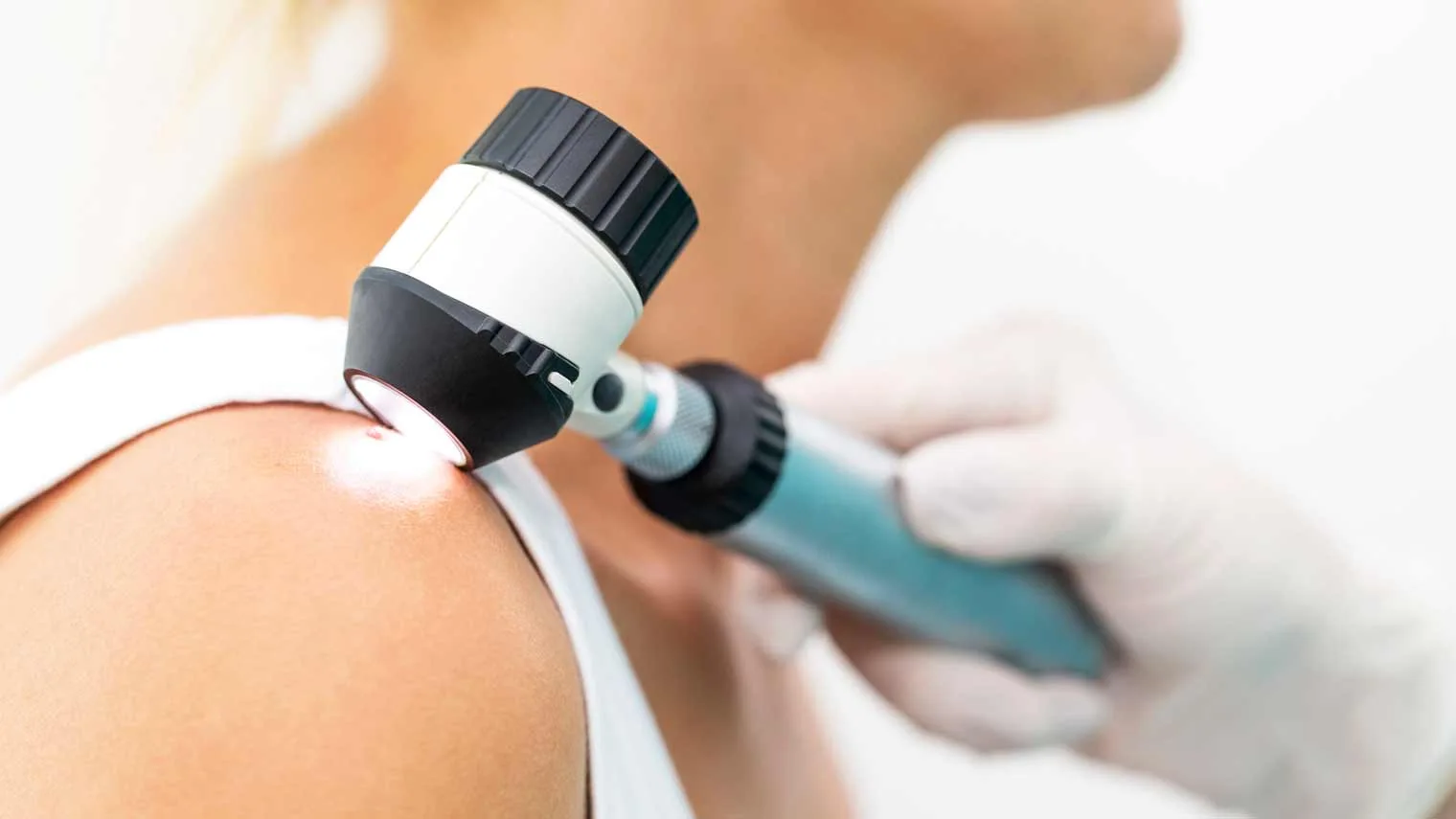
If you’ve been diagnosed with more than one skin cancer, it’s natural to expect a bigger September 11th Victim Compensation Fund (VCF) award.
In most cases it doesn’t work that way: the VCF treats basal cell and squamous cell carcinoma as a single category of non-melanoma 9/11 skin cancer with a $90,000 baseline, no matter how many are certified. Melanoma is the exception. It carries a $250,000 award, and in our experience a claimant certified for both reaches a combined $300,000, a figure the VCF does not publish.
In our experience the VCF doesn’t simply add the two awards together. It starts from the higher-severity condition (melanoma, $250,000) and adds $50,000 for the additional certified cancer, reaching a combined $300,000. The VCF does not publish this step-up, so treat it as a pattern we see rather than a stated rule. Here’s how the VCF actually calculates it, and what can push an award past the baseline.
How Is a Skin Cancer Award Calculated?
The September 11th Victim Compensation Fund (VCF) sets non-economic loss awards for a single cancer generally between $90,000 and $250,000, depending on the type of cancer certified by the World Trade Center (WTC) Health Program and the medical evidence of severity in the file.
For the full award framework across all cancer types, see our VCF payout chart. This post focuses on a narrower and frequently misunderstood question: what happens when more than one skin cancer diagnosis is certified on the same claim. For the broader picture on eligibility, latency, and how a 9/11 skin cancer claim gets filed, see our skin cancer resource page.
Why Are Melanoma and Non-Melanoma Skin Cancer Awards So Different?
Basal cell carcinoma and squamous cell carcinoma are, medically speaking, far less aggressive than melanoma. They are usually treated with a localized excision and rarely metastasize, which is why baseline awards are issued at the $90,000 level rather than the higher end of the cancer award range.
Melanoma carries a meaningfully higher risk of spreading and danger if it is not caught early, which is why it is typically awarded $250,000. The distinction is not that the VCF favors one diagnosis over another. It is that the two diseases carry different medical risks, and the award framework is built to reflect that.
Does Having Multiple Skin Cancer Diagnoses Increase the Award?
Generally, no if the multiple diagnoses are all non-melanoma skin cancers, but generally yes if one of the certified diagnoses is melanoma. Multiple non-melanoma certifications, whether basal cell and squamous cell carcinoma together, the same type at more than one site, or a recurrence at a previous site, are generally awarded $90,000 in total.
Melanoma carries a meaningfully higher risk of spreading, so it is evaluated on its own, higher-severity footing: certifying it alongside an existing non-melanoma skin cancer diagnosis generally raises the combined award to $300,000.
This feels counterintuitive to a lot of claimants suffering from multiple types of skin cancers at multiple locations on their bodies. The value of multiple non-melanoma diagnoses or the same type at multiple sites feels like it should be worth more than the value of one. But the VCF’s framework is oriented around the overall severity of the condition(s) being compensated, not the quantity.
Though it is possible, it is rare for a non-melanoma skin cancer award to exceed $90,000. The circumstances in which the VCF may consider an award beyond that level generally require an extensive medical record demonstrating ongoing and frequent recurrences, metastasis, and a showing of permanent complications, resulting from those recurrences, metastases, or otherwise from treatment, that go well beyond what a routine excision produces.
Because the initial award calculation is built around the $90,000 baseline for this category of cancer, a claimant seeking beyond that amount will, in most cases we see, ultimately need to present that medical evidence at a compensation appeal hearing, and testify as to the effects of long-term complications on their day-to-day lives. This is worth setting expectations around early. It is a real path, but far from a quick or a common one.
This is a general description of how the VCF’s published framework operates, not a prediction about the outcome of any individual claim. Every case turns on its own medical record, and the Special Master retains discretion to weigh the specific facts presented.
What If a Skin Cancer Diagnosis Progresses or a New One Develops Later?
If your circumstances change after an award, whether an existing non-melanoma diagnosis progresses, you are later diagnosed with melanoma, or a new lesion is diagnosed or certified at an additional site, the correct path is not a new claim, but rather an amendment to your existing claim.
Two circumstances typically justify an amendment relevant to a changing skin cancer diagnosis:
- The WTC Health Program certifies you for a condition that was not part of your original claim, such as a melanoma diagnosis that develops after you were originally compensated only for non-melanoma skin cancer.
- An already-certified condition substantially worsens, resulting in loss that was not previously compensated, such as new evidence of recurrence and resulting permanent complications that were not present when your original award was calculated.
In either case, the sequence matters. Any new type of skin cancer condition needs to be certified for treatment by the WTC Health Program before the VCF will review an amendment on its basis. Filing the amendment first, without that underlying certification in hand, is unlikely to move the claim forward and can simply add time to a process that already takes a while to work through.
For background on which skin cancer diagnoses and related conditions are covered in the first place, see our Covered Conditions resource page. For the mechanics of updating an existing award, see our Amendments resource page.
What I Have Seen
I have sat across the table from people who received a $90,000 award for basal cell and squamous cell carcinoma and felt, understandably, like the number did not reflect what they had been through: multiple procedures, multiple scars, years of follow-up dermatology visits. The number is not a reflection of what a claimant endured. It is a reflection of how the VCF’s framework categorizes the underlying disease.
When a client’s case genuinely goes beyond that, involving recurrences, extensive scarring with functional limitations, complications that persist years after treatment, we talk candidly about what pursuing more than $90,000 actually involves: a compensation appeal, often a hearing, and a detailed medical record in support.
Where I think experienced counsel earns its keep is in the cases that are not that simple. A claimant with a long history of non-melanoma skin cancer who is later diagnosed with melanoma should not assume that diagnosis simply gets folded into the old award.
It generally calls for its own amendment, built on its own certification, evaluated on its own medical evidence. Knowing when a case has moved from “more of the same” to “a genuinely different risk profile” is a judgment call, and it is one we make with clients every week.
If you or a family member have ever been diagnosed with a 9/11-related skin cancer, whether it is non-melanoma or melanoma, contact Baione Law - 9/11 Claim Center for a free case review. Our team handles VCF and World Trade Center Health Program claims exclusively.
You were there. We’ll be here.™